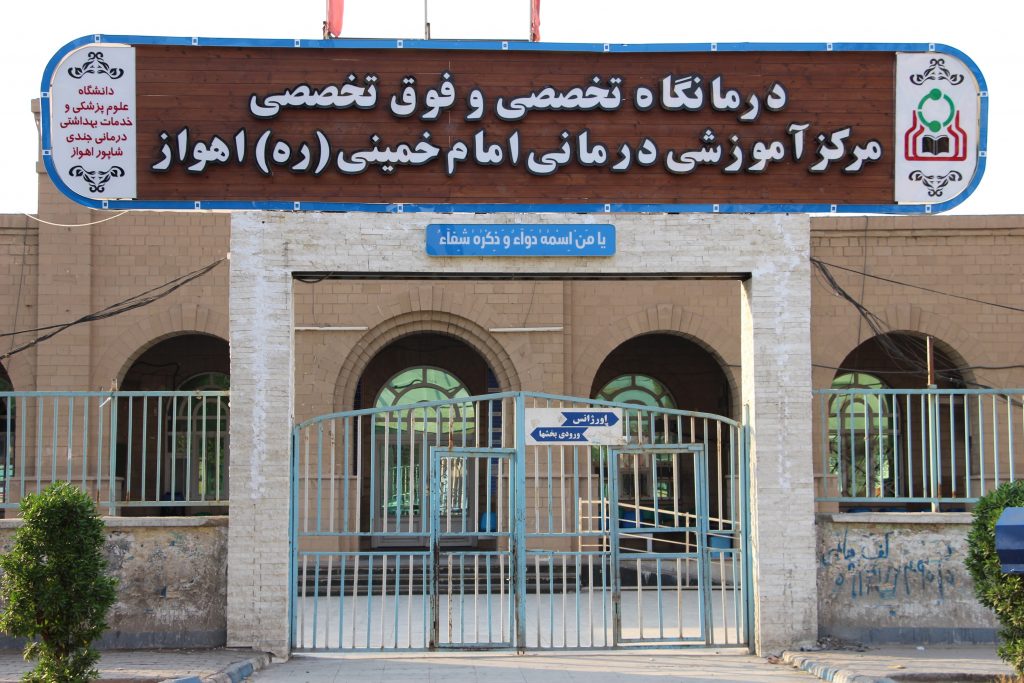
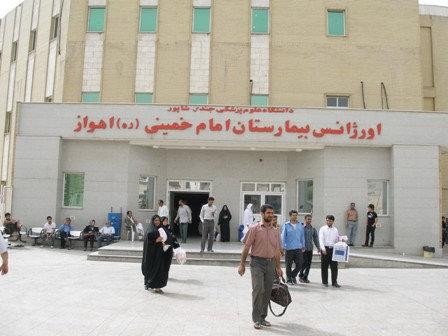
imam khomaini hospital
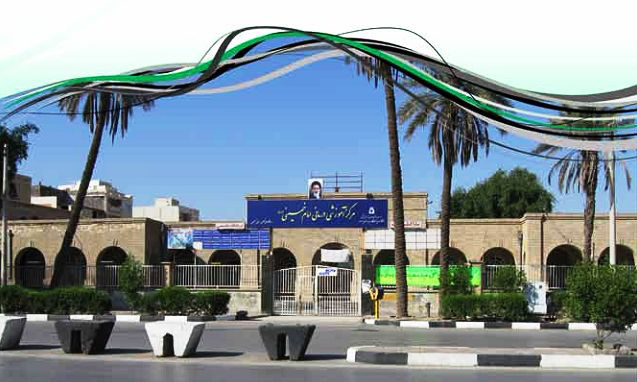
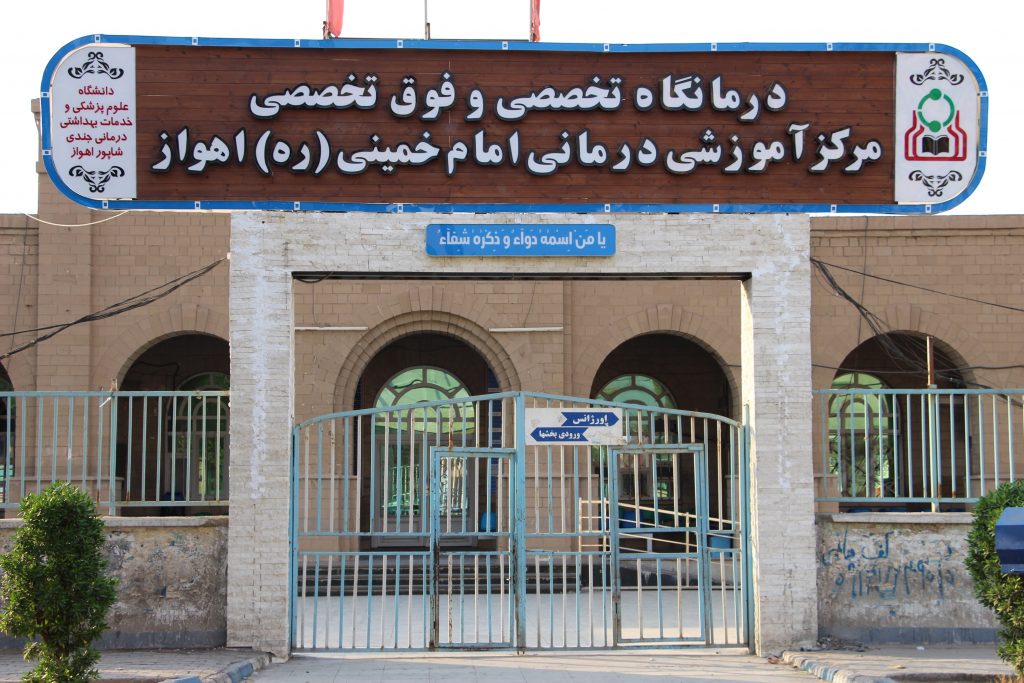

Contact Clinic
Address :
Ahwaz - Azadegan Street - Imam Khomeini Rehabilitation Center in Ahvaz
Postcode 6193673111
PO Box 1519
Contact Center Number:
32222114 - 32222818 - 32222922
Ahvaz Phone Number: 061
-------------------------------------
SMS system number
100013002299
-------------------------------------
Office of the President: 32222085
Office of Deputy Education: 32216504
Fox Presidency: 32225763
32923988 Complaints Investigation Unit
-------------------------------------
Address :
Ahwaz - Azadegan Street - Imam Khomeini Rehabilitation Center in Ahvaz
Postcode 6193673111
PO Box 1519
4379/5000 Gundishapur University was the first university in the world to be founded in 271 BC in Gundishapur, Khuzestan, by Shapur II's command. At that university, which the Arabs called Jundishapur, there were courses in medicine, philosophy, theology, and sciences, especially astronomy. Gandhi Shapur also had a large teaching hospital, observatory, and library in which writings were kept in Pahlavi, Greek, Hindi, and Syriac. That university became a model for the establishment of Bethlehem in Baghdad. Founding of Gundishapur Gundishapur was one of the seven major cities of the Persian Empire in Khuzestan province. Some writers attribute the founding of the city to the Parthians, but others believe that it was built by Shapur I, the second Sassanid king, after the defeat of the Roman Emperor Valerianus in 260 AD and served as a military base and It housed 70,000 Roman captives. The term Wendy Shapur, which means "conquered by Shapur", supports this view. Ferdowsi also describes how this city came into being: Holding where the bad guys got him, I got one Where is Gandeshapur Vera besides this name Narani Vera Khouzian has this canvas and everyone has it He was just born in a country full of people and water and profit and loss One was Charsan Abad Boom which was rich in Roman captives Other historians have written that Ardeshir I was founded by Gandhi Shapur and his son Shapur completed it. For example, Ibn Nadim writes: "Ardashir sent people to the areas to collect books from India and Rome and the remnants of the artifacts left in Iraq and compiled from them what was scattered and compiled what was contained." In his opinion, Ardashir wanted to build a school that would not be as grand and magnificent. But he did not find the time, and his son Shapur I went on his way. Gundishapur, at the beginning of a small village called Nilawa, became a vast and prosperous city at the time of Shapur II. When Roman Emperor Julian invaded Iran in 363, Shapur II assembled his army there. Hence, Vanduishapur or Shapur was known as Shapur, meaning Lashkar Gah, and slowly became Gundishapur and was for a long time the capital of the Sasanians. Until the onslaught of the Arabs, the city was still one of the major cities of Khuzestan and Iran and was known in their language as Jundishapur. But after the establishment of Bethlehem in Baghdad and many of its scholars and scholars went to that Islamic scientific center, it slowly lost its significance and, after 900 years of prosperity, it was destroyed, and now its ruins near Shushtar in a place called the Shah. Abad, is left. Finally Gundishapur In the year 148 AH, Mansour suffered a serious illness that doctors could not cure. Therefore, Georgis Bakhtishou, son of the director of the Gundishapur Hospital, was invited to Baghdad for treatment. The Iranian physician stayed in Baghdad for four years after Mansour's treatment and trained Iranian medicine in Baghdad. Upon his return to Iran, he succeeded Isis bin Shahlafa, and thus, Iranian medicine reached the Islamic world. During the Aaron and Ma'mun Abbasi period, the renowned doctors of Gundishapur University were also summoned to the capital of the Islamic world, Baghdad, and found a decent place in that city. However, it did not diminish the dynamics of the University of Gundishapur and its renowned hospital, and remained the world's most advanced scientific center for at least another century. With the advent of the Gundishapur scholars at the center of the Islamic world, Gundishapur's scientific achievements also reached Baghdad and other Islamic lands through them, and thereby flourished knowledge there. Thus, although the Gundishapur building slowly collapsed in the third and fourth centuries AH, its spiritual influence continued and if we consider the progress of science to be a continuous work of history, we still enjoy its achievements. As most hospitals in the Islamic world were modeled on Gandhi Shapur Hospital, they became the pioneers of European hospitals. There are so many medicines that are written in Arabic medical books with their Persian name and are still read in Arabic with the same names. How many minerals came into Arabic with their Persian name. How many philosophers wrote in Arabic but were Iranian, and many Muslim mathematicians and astronomers who returned books like Zij al-Shah, Zij al-Shahryar from Pahlavi to Arabic. Therefore, the Muslims, through the Iranians and the Gundishapur Scientific Foundation, became acquainted with the knowledge of ancestors, Indians, Greeks, Iranians, Chinese and many others. Muslim scholars, most of whom were Iranians, spread that knowledge and then donated it to the Europeans. Send feedback History Saved Community
 English
 Persian
.gif) Arabic
 ESCAD
 AAID
 ITI
 ISO 9001:2008

Contact Clinic imam khomaini hospital
- Fast response on your request
- Medical coordinator informs you on all treatment options
- No hidden or extra fees
- Transfer and accomodation assistance